
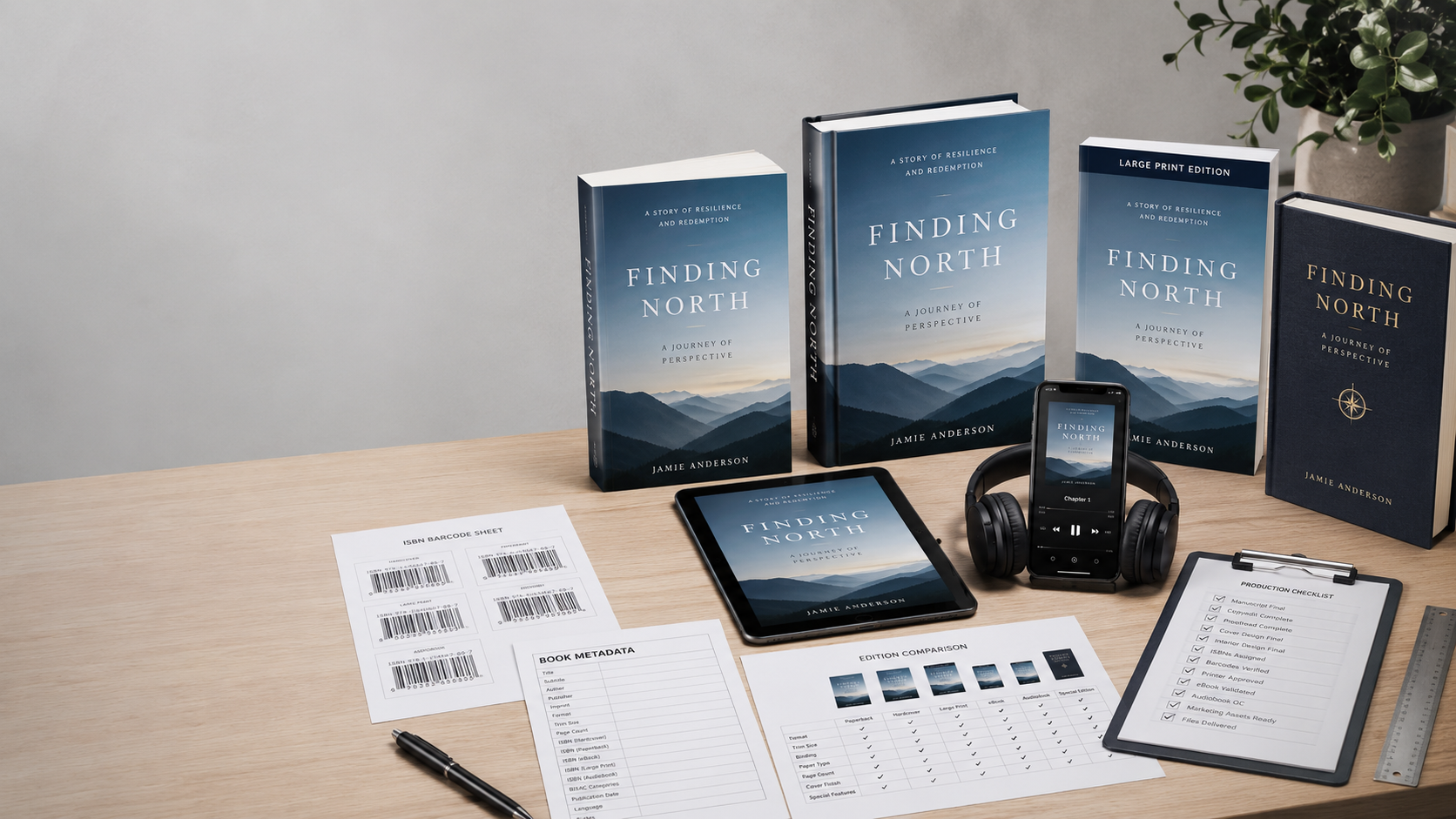
Defining the Book, Edition, Format, and Audience
Learn how to define a book’s title, edition, audience, formats, and ISBNs while maintaining consistent metadata across paperback, hardcover, ebook, large-print, audiobook, and special editions.
Publishing a professional book begins long before the manuscript is uploaded to a retailer, sent to a printer, or converted into an ebook. It begins with a clear definition of the product being published.
A book is not simply a manuscript placed inside a cover. It is an identified commercial product with a title, contributor information, language, edition status, audience, format, publication date, publisher identity, and distribution record. These details become part of the book’s metadata, which is used by retailers, libraries, wholesalers, distributors, search engines, and readers to understand exactly what the product is.
The International Standard Book Number, commonly called the ISBN, identifies a specific book product and connects it to the publisher responsible for that product. Bowker, the official ISBN agency for the United States, explains that ISBNs provide unique identification and help books move through the commercial supply chain.
When a publisher fails to define the book correctly, problems can spread across every stage of publication. Retail listings may conflict. Paperback and hardcover editions may become disconnected. Reviews may appear on the wrong product page. Libraries may receive incomplete information. Revised editions may be mistaken for earlier versions. Readers may order one format while expecting another.
These problems are often described as retailer errors or distribution errors, but they frequently begin with incomplete or inconsistent product planning.
Professional publishing standards require the publisher to define the book, edition, format, and audience before assigning ISBNs, creating final covers, building retail listings, or approving production files.
Start by Defining the Book Itself
Before defining individual formats, establish the identity of the work. This information should be recorded in a central title-information document or metadata record that becomes the authoritative source for everyone involved in production and distribution.
At minimum, define the following:
Exact title
Exact subtitle, when applicable
Author or contributor name
Author-name presentation
Language
Edition designation
Series name and series number
Publisher or imprint
Intended audience
Subject classification
Publication territory
Planned publication date
These details should not be treated as informal marketing ideas that can be changed independently at different stages. They form the book’s bibliographic identity.
Bowker defines metadata as the title information associated with a book, including basic information such as the title and author, as well as descriptive information about the book and author. More complete metadata may also include the ISBN, publisher, price, dimensions, publication date, subject information, description, and cover image.
A publisher should therefore settle the identifying information before producing multiple versions of the book.
Establish the Exact Title and Subtitle
The title entered into the ISBN record should match the title shown on the title page and the title supplied to distributors and retailers. The same principle applies to the subtitle.
Small differences may appear harmless but can create separate or conflicting records. For example, these variations should not be treated casually:
The Independent Publisher’s Handbook
Independent Publisher’s Handbook
The Independent Publishers Handbook
The Independent Publisher Handbook
Each version communicates a slightly different title. Once the book enters the supply chain, these inconsistencies can make it harder for automated systems to determine whether the records refer to the same publication.
Select the final title and subtitle before registering the ISBN or releasing metadata. Use that wording consistently on the cover, title page, copyright page, distribution records, retail listings, press materials, author website, and promotional content.
The cover may use design treatments such as capitalization, line breaks, or typography, but the wording itself should remain consistent.
Define the Author Name Exactly
The author’s name is part of the book’s identity. Determine how it will appear before publication.
Possible presentations include:
Full legal name
Professional name
Pen name
Initials and surname
Name with a middle initial
Name with a suffix
Organization acting as author
“Rebecca M. Carter,” “Rebecca Carter,” and “R. M. Carter” may refer to the same individual, but retail and library systems may not always connect them automatically.
An author who has published previous books should normally maintain the same public name unless there is a deliberate reason to change it. Consistent naming helps retailer systems, library catalogs, author pages, and readers connect the books to the correct contributor.
Publishers should also distinguish between the author and other contributors. Editors, illustrators, translators, photographers, foreword writers, and narrators may require separate contributor roles in the metadata.
Identify the Language
Specify the primary language of the publication. A translation should be treated as a separate publishing product rather than a minor variation of the original-language edition.
An English-language paperback and a Spanish-language paperback are not interchangeable products. They have different content, audiences, metadata, and purchasing expectations. Each should be identified separately and assigned the appropriate ISBN.
For bilingual books, identify the languages accurately and consistently. The language description on the retailer page should match the actual content of the book.
Establish Series Information
When the book belongs to a series, define the official series title and the book’s position within that series.
Record:
Exact series title
Volume or sequence number
Whether the book can stand alone
Related editions within the series
Consistent naming conventions
Do not alternate between similar series names. A series called “The Bitter Creek Chronicles” should not appear elsewhere as “Bitter Creek Chronicle,” “Bitter Creek Series,” or “Chronicles of Bitter Creek” unless these are intentionally different collections.
Bowker encourages publishers to synchronize metadata across related products, including series information and metadata for hardcover, paperback, and ebook editions.
Consistent series metadata helps retailers group the books in the correct reading order and gives readers confidence that they are buying the intended volume.
Define the Intended Audience
A book should be developed and classified for an identifiable audience. “Everyone” is not a useful audience definition.
The intended audience affects editorial decisions, cover design, trim size, vocabulary, subject classification, pricing, marketing, distribution, and format selection.
A practical audience definition may include:
Reader age or educational level
Experience with the subject
Primary reason for purchasing the book
Fiction or nonfiction preferences
Professional or general-interest use
Accessibility needs
Geographic or cultural relevance
Preferred reading format
For example, a self-publishing guide for first-time authors requires a different structure from a professional reference manual for experienced publishing consultants. A historical novel written for adults requires different positioning from a middle-grade historical adventure. A recovery journal for new amputees requires different language and design from a clinical rehabilitation textbook.
The publisher should be able to complete this sentence:
This book is primarily for readers who __________ and need or want __________.
That statement should guide the book’s editorial development and commercial presentation.
Audience and Subject Classification
The intended audience should agree with the subject categories assigned to the book. A mismatch between content, audience, description, and category information can weaken discoverability and create incorrect reader expectations.
The Book Industry Study Group describes metadata as the information publishers use to communicate information about books and book-related products throughout the supply chain. Printers, distributors, retailers, libraries, educational institutions, and consumers all depend on that information.
Audience classification should therefore be accurate rather than aspirational. A book should not be placed in a juvenile category merely because the publisher hopes parents will buy it, nor should a specialized professional book be described as a general beginner’s guide when it assumes advanced knowledge.
The best category is the one that most accurately describes the book readers will receive.
Define Every Product Format Separately
A single manuscript can become several separately traded products. Each format must be defined independently, even when all formats contain substantially the same core work.
Common formats include:
Paperback
Hardcover
Ebook
Large-print edition
Audiobook
Special edition
Workbook edition
Library binding
Boxed set
Each product may have a different ISBN, price, publication date, cover file, interior file, page count, dimensions, production method, and distribution channel.
The publisher should not think of these as upload options attached to one generic book listing. They are connected but distinct products.
Paperback Edition
Define the paperback by its physical production specifications.
These may include:
Trim size
Binding method
Paper color
Paper weight
Interior ink
Bleed requirements
Final page count
Cover finish
Retail price
Distribution territory
A 6 × 9-inch trade paperback is not necessarily the same product as an 8.5 × 11-inch workbook edition, even when the written content is similar. Differences in trim size, layout, usability, or content presentation may establish the larger version as a separate product.
The paperback’s metadata should describe the actual book being sold, not a generic version of the manuscript.
Hardcover Edition
The hardcover edition should be defined independently from the paperback.
Important details include:
Case laminate, cloth, or jacketed cover
Trim size
Binding construction
Dust jacket or printed case
Paper and interior specifications
Page count
Retail price
Special content or features
A hardcover generally receives its own ISBN because it is a separately traded binding. ISBN.org states that each format or binding must have a separate ISBN.
The hardcover may contain the same text as the paperback, but the physical product, manufacturing cost, retail price, and purchasing decision are different.
Do not place the paperback ISBN on the hardcover or reuse the hardcover ISBN for the paperback.
Ebook Edition
The ebook is a digital product and should be identified separately from printed editions.
Define:
File format
Reflowable or fixed layout
Included images
Accessibility features
Navigation
Digital rights settings
Territorial availability
Retail price
Distribution channels
Different ebook file types may require separate identification when they are sold as distinguishable products. Platform practices vary, particularly when a retailer supplies its own identifier or distributes only through a closed system. The publisher should determine the identification requirements for each distribution arrangement before assigning or reusing an ISBN.
The central principle remains that a separately available product should be clearly and accurately identifiable.
The ebook title, subtitle, author name, edition statement, series information, and description should remain consistent with the corresponding print editions unless the ebook contains meaningful content differences.
Large-Print Edition
A large-print book is more than a standard paperback with a slightly larger font. It should be intentionally designed for readers who need improved legibility.
The publisher should define:
Font size
Typeface
Line spacing
Page size
Contrast
Margin width
Navigation
Final page count
Cover identification
Large-print labeling
Because the large-print edition is a separately traded format with different physical specifications and a distinct reader expectation, it should generally receive its own ISBN.
The cover and retail metadata should identify it clearly as a large-print edition. A customer should never have to guess whether a listing represents the standard paperback or the accessible version.
Audiobook Edition
An audiobook is a performance-based product rather than a visual reproduction of the printed pages.
Define:
Narrator or narrators
Unabridged or abridged status
Running time
Audio format
Chapter structure
Production company
Publication date
Territorial rights
Retail and library distribution
Bonus material
ISBN.org explains that the ISBN standard may identify book-like products such as audiobooks.
An audiobook should not use the ISBN assigned to the paperback, hardcover, or ebook. The narration, audio production, runtime, and delivery format distinguish it from the reading editions.
The narrator should also be included as a contributor in the audiobook metadata.
Special Edition
A special edition must be defined according to what makes it special.
Possible features include:
New foreword
Bonus chapter
Author annotations
Illustrations
Signed or numbered copies
Premium binding
Alternate cover
Slipcase
Decorative endpapers
Expanded content
Exclusive companion materials
A cosmetic marketing variation does not always require a new ISBN. ISBN.org notes that a cover change made only to refresh marketing generally does not require a new ISBN. However, a new ISBN may be appropriate when the changed product is substantially different or could create a different customer expectation.
The publisher should evaluate the complete product, not merely the cover image.
A signed copy of an otherwise unchanged book sold directly by the author may not require a new ISBN. A premium collector’s edition with a new binding, additional content, numbered copies, illustrations, and a slipcase is more clearly a separately traded product and should be identified accordingly.
Understand the ISBN’s Function
An ISBN is not a copyright registration, proof of authorship, marketing license, or guarantee of retail acceptance.
It is a product identifier.
It identifies a specific book or book-like product and connects that product to the publisher responsible for it. Bowker states that ISBNs simplify the distribution of books through the supply chain and make titles easier for bookstores and libraries to identify.
In the United States, Bowker is the official ISBN agency. Publishers based in other countries should obtain ISBNs through the agency responsible for their country or territory.
Once assigned, an ISBN should not be reused for another product. ISBN.org states that an assigned ISBN can never be reused.
This remains true even when the original book is cancelled, withdrawn, or allowed to go out of print.
Each Separately Traded Format Generally Requires Its Own ISBN
The central ISBN rule is straightforward:
A separately traded format or binding generally requires its own ISBN.
For example:
Paperback: one ISBN
Hardcover: another ISBN
Ebook: another ISBN when publisher-supplied identification is used
Large-print paperback: another ISBN
Audiobook: another ISBN
Collector’s edition: another ISBN when it is a distinct product
These products may share a title, author, series, and core content, but they are not the same physical or digital item.
A bookseller ordering the hardcover needs an identifier that does not accidentally return the paperback. A library purchasing the large-print edition needs to distinguish it from the standard-print edition. An audiobook customer expects an audio recording rather than an ebook download.
Separate ISBNs make these distinctions possible.
Corrected Printing Versus Revised Edition
Publishers must distinguish between a corrected printing and a substantially revised edition.
The difference is based on the significance of the changes, not merely the number of files replaced or the amount of time that has passed.
Corrected Printing
A corrected printing contains minor corrections that do not substantially change the work.
Examples include:
Correcting typographical errors
Repairing punctuation
Fixing minor formatting problems
Correcting an isolated page reference
Repairing a broken hyperlink
Adjusting minor cover text
Correcting a contributor’s misspelled name
ISBN.org explains that a reprint involves printing more copies without substantial changes and may include the correction of a few typographical errors. Minor typo corrections do not require a new ISBN.
The corrected printing normally retains the existing edition designation and ISBN.
The publisher should still maintain internal production records showing when corrections were introduced. A print-history line may be used when appropriate, particularly in traditionally managed editions or scholarly works.
Substantially Revised Edition
A revised edition contains changes significant enough to alter the product a customer expects to receive.
Examples may include:
Rewritten or replaced chapters
Significant new content
Updated professional or technical standards
Changed conclusions or recommendations
New exercises or instructional material
Substantial restructuring
New research or documentation
Major changes to illustrations or tables
Significant adaptation for a different audience
ISBN.org describes a new edition as one containing substantial changes, particularly changes that could cause a customer to complain that the received product was not what was expected. A revised edition requires a new ISBN.
The new edition should carry:
A new edition designation
A new ISBN for each separately traded format
Updated metadata
Updated publication date
Updated cover and copyright-page information
A revised description when appropriate
For example, a “Second Edition” paperback needs a new paperback ISBN. Its hardcover, ebook, large-print, and audiobook versions may also require new identifiers when those revised products are released.
The ISBNs from the first edition must not be transferred to the second edition.
Maintain Consistency Across All Formats
Although each format is a separate product, the identifying information connecting the formats should remain consistent.
Core information normally shared across corresponding formats includes:
Title
Subtitle
Primary author name
Series title
Series number
Language
Edition designation
Publisher or imprint
Core book description
Subject positioning
Format-specific information should then distinguish each product:
ISBN
Binding or digital format
Trim size
Page count
File type
Narrator
Running time
Price
Publication date
Accessibility designation
Bowker advises publishers to synchronize metadata across related products, including hardcover, paperback, and ebook editions. The Book Industry Study Group similarly promotes timely, accurate, and high-quality metadata for all book formats.
This consistency helps retailers connect editions on one book page or within one related-product group. It can also help reviews, series information, author pages, and format options appear correctly.
Consistency does not mean copying every field without review. Page count, dimensions, price, ISBN, and format description must reflect the individual product.
Create a Master Product Record
Every publisher should maintain a master product record for each title.
A useful record should contain one section for information shared by the work and separate sections for each product format.
Shared Work Information
Record:
Final title
Final subtitle
Primary author
Other contributors
Language
Series
Edition
Audience
Description
Subject categories
Publisher
Imprint
Rights territory
Format-Specific Information
For each format, record:
ISBN
Format or binding
Trim size or file type
Page count or running time
Publication date
Price
Cover filename
Interior filename
Distribution channels
Production status
This master record should be consulted whenever information is entered into Bowker, a print-on-demand platform, an ebook distributor, an audiobook distributor, a wholesaler, a library service, or a retailer portal.
Do not rely on memory or copy information from an old retail listing without verifying it against the official product record.
A Practical Prepublication Review
Before releasing any format, confirm the following:
The title and subtitle match the title page and metadata.
The author’s name is presented consistently.
The language is correct.
The edition designation is accurate.
Series information matches the other books in the series.
The audience and categories reflect the actual content.
The ISBN belongs to the correct format.
The ISBN has not been used previously.
The cover displays the correct format and edition information.
The copyright page contains the correct ISBN.
The page count or runtime is accurate.
The description does not promise features absent from that format.
Related formats share consistent core metadata.
Revised editions are clearly distinguished from previous editions.
Distribution records match the final product files.
This review should occur before publication, not after incorrect listings begin appearing across retailers.
Professional Identification Builds Reader Trust
Book identification may appear administrative, but it directly affects the reader’s experience.
A reader should be able to determine:
What the book is
Who created it
Which edition is being sold
Which format will be delivered
Whether it belongs to a series
Whether it is appropriate for the reader
Whether it contains the expected content
Clear product definition also protects the publisher. It reduces confusion, returns, duplicate listings, mismatched files, incorrect reviews, and disputes over edition differences.
The professional standard is not merely to finish a manuscript and make it available. The standard is to create a clearly identified product, assign the correct identifier, maintain accurate metadata, and communicate that information consistently throughout the publishing supply chain.
When the book, edition, format, and audience are defined before production begins, every later stage becomes more reliable. Editing decisions become clearer. Cover design reflects the correct audience. ISBNs are assigned properly. Retail records remain aligned. Related formats can be connected. Revised editions can be distinguished from corrected printings.
A well-defined book is easier to produce, easier to distribute, easier to discover, and easier for readers to trust.
Authoritative Publishing Resources
ISBN.org: Publication Formats, Reprints, and Editions
Official guidance explaining format identification, reprints, corrections, revised editions, and ISBN changes.
Bowker: ISBN Services for the United States
Information from the official United States ISBN agency concerning ISBN ownership, identification, distribution, and discoverability.
Book Industry Study Group: Metadata Best Practices
Publishing-industry guidance for creating, managing, and distributing accurate book metadata.